
August 22nd, 2026
Myth #3: Artificial Intelligence will replace cybersecurity analysts
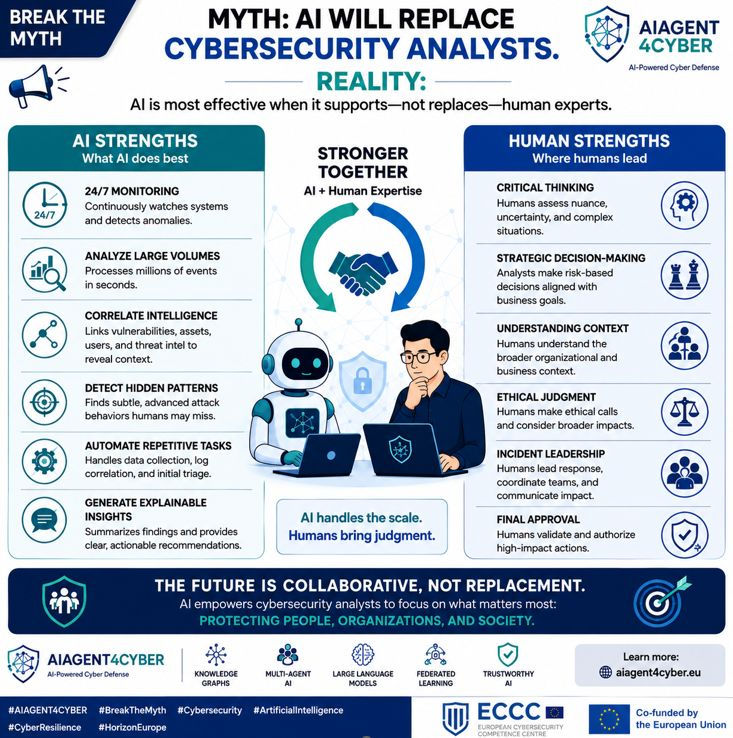
Reality: AI is transforming cybersecurity - but not by replacing people.
Modern cyberattacks are becoming faster, more sophisticated, and increasingly difficult to detect. Security Operations Centers (SOCs) often process thousands of alerts every day, many of which are repetitive or false positives. This can overwhelm analysts and make it harder to focus on genuine threats. This is where AI can make a real difference. Within the AIAGENT4CYBER project, we are exploring how Multi-Agent AI, Knowledge Graphs, and Large Language Models (LLMs) can work together to assist cybersecurity professionals.
Instead of replacing analysts, AI can:
• Continuously monitor large volumes of security events from multiple sources.
• Correlate vulnerabilities, threat intelligence, network activities, and attack patterns to provide richer context.
• Prioritize alerts based on risk, reducing alert fatigue.
• Generate explainable recommendations that help analysts understand 𝘸𝘩𝘺 a threat has been identified.
• Automate repetitive tasks such as data aggregation, log correlation, and initial incident triage.
Human expertise remains essential. Security analysts provide critical thinking, understand organizational context, make strategic decisions, and validate high-impact actions. AI enhances these capabilities by handling data-intensive tasks and presenting relevant insights more efficiently.
The future of cybersecurity is not AI versus humans - it is AI working alongside humans to build more resilient, trustworthy, and proactive cyber defense systems.